
Pharmaceutical companies face growing regulatory pressure (US, EU, India) for data integrity and real-time compliance, alongside competitive demands for faster, safer product launches. Digital QMS pharma solutions are now vital, offering centralized, validated quality management. The focus is shifting to how AI will enhance these established digital QMS frameworks, acting as a capability layer rather than a disruptive force.

What Is a Digital QMS in Pharma?
A digital QMS is an integrated electronic platform that manages the full spectrum of quality processes within pharmaceutical manufacturing and distribution. These quality management systems replace fragmented paper-based workflows and disconnected legacy applications with unified, cloud-accessible solutions.
Core capabilities typically include document control, deviation management, corrective actions and preventive actions (CAPA), audit management, training administration, and supplier quality oversight. When implemented effectively, a digital QMS creates a single source of truth for quality data across global operations.
For pharmaceutical companies operating under stringent regulatory requirements, digital QMS platforms offer critical advantages. They ensure compliance with FDA 21 CFR Part 11, EU Annex 11, and similar frameworks governing electronic records and signatures. More importantly, they generate the structured, validated data that regulators increasingly expect during inspections.
This data foundation serves another crucial purpose. It creates the prerequisite infrastructure for advanced analytics and machine learning in pharma quality.
Why Pharmaceutical Companies Are Prioritizing Digital QMS Now?
The acceleration toward digital quality management systems reflects converging pressures that pharmaceutical companies can no longer ignore. Several factors are driving urgent investment across global markets:
- Heightened regulatory scrutiny around data integrity and electronic record-keeping practices
- Complex global supply chains require real-time visibility into quality metrics across manufacturing sites
- Hybrid and remote work models demanding cloud-accessible quality systems for distributed teams
- Competitive pressure to accelerate time-to-market while maintaining uncompromising product quality
- The substantial financial and reputational cost of quality failures, recalls, and warning letters
- Growing executive mandates for continuous improvement supported by measurable quality analytics
Legacy systems and paper-based/siloed processes create quality blind spots, making proactive response difficult. Digital QMS platforms centralize data for better decision-making. Regulatory bodies in the US, EU, and India expect digital transformation; organizations that delay it risk compliance issues and falling behind industry peers in leveraging connected quality ecosystems.
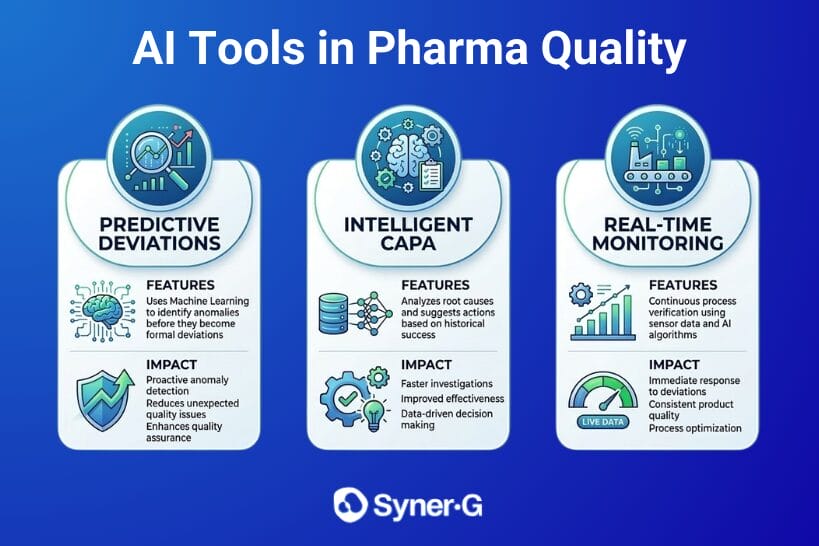
Emerging AI Tools in Pharma Quality
As digital QMS adoption matures, forward-thinking organizations are exploring how AI quality management pharma applications can enhance existing capabilities. This represents an evolution rather than a disruption, as AI tools depend entirely on the structured, validated data that digital quality management systems generate.
Predictive Deviation Detection
Predictive deviation detection employs machine learning in pharma quality to analyze historical data and identify anomalies before they become formal deviations. These models spot subtle signals, enabling proactive intervention and shifting quality processes from reactive to predictive risk management.
Intelligent CAPA Management
AI-assisted CAPA systems can analyze root cause narratives, suggest likely contributing factors, and recommend corrective actions based on successful resolutions from similar past events. This accelerates investigation cycles while improving consistency across quality processes. Quality managers benefit from faster closure times and more standardized approaches to addressing recurring issues.
Real-Time Quality Monitoring
Real-time quality monitoring combines sensor data with AI algorithms for continuous process verification. Rather than relying solely on batch-end testing, these systems provide ongoing assurance that manufacturing parameters remain within validated specifications, protecting product quality throughout production. This capability supports continuous improvement initiatives by surfacing optimization opportunities that manual review might miss.
Regional Adoption Trends
It is important to acknowledge that these capabilities remain emerging rather than universally deployed. Maturity varies significantly across organizations and regions. US-based pharmaceutical companies are leading pilot implementations, while EU regulators are developing validation frameworks for AI in regulated environments. India continues scaling foundational digital infrastructure that will eventually support advanced analytics.
For quality leaders evaluating these technologies, the message is clear. Digital QMS is the prerequisite. AI is the emerging enhancement that will increasingly differentiate quality organizations committed to operational excellence.
Practical Considerations for Quality Leaders Evaluating AI-Enhanced QMS
Quality managers and digital transformation leads must approach AI integration strategically. Enthusiasm for emerging technologies should be tempered with practical planning that accounts for regulatory realities and organizational readiness.
The following considerations can guide evaluation efforts:
- Assess digital maturity first, as AI initiatives consistently fail without clean, structured quality data flowing through validated systems
- Prioritize use cases with measurable ROI, such as deviation reduction rates or CAPA cycle time improvements
- Making sure any AI tools meet validation requirements under 21 CFR Part 11 and Annex 11 before deployment in regulated quality processes
- Engage cross-functional stakeholders early, including Quality, IT, Regulatory Affairs, and manufacturing operations
- Plan for change management comprehensively, recognizing that technology adoption requires cultural alignment and workforce training
- Evaluate vendor partners carefully, prioritizing those with demonstrated domain expertise in pharmaceutical quality management systems
Pharma companies rushing AI adoption without solid digital QMS foundations often face major setbacks. Those building methodically on robust QMS platforms, however, are well-positioned for successful AI integration as technology and regulations evolve. Effective quality leaders view transformation itself as continuous improvement. Focused pilot programs enable teams to build expertise and demonstrate value before global scaling.

Building a Future-Ready Quality System
Strategic investment in digital QMS and AI offers pharmaceutical quality organizations a competitive advantage in product quality and compliance agility. A future-ready quality system requires first consolidating processes onto validated digital platforms to eliminate silos and structure data for advanced analytics.
With this foundation, quality leaders can pilot AI applications to build familiarity and prepare for evolving regulations. Successful transformation demands partnerships with experts in both pharma quality management and digital solutions.
Companies that view quality as a strategic capability, supported by digital QMS and AI enhancements, will achieve proactive risk management, faster corrective actions, and sustained quality excellence.
Frequently Asked Questions
What is a digital QMS?
A digital QMS centralizes and automates quality management, replacing paper with electronic systems for documentation, audits, and compliance. It maintains data integrity and provides a single, real-time source of truth for global quality operations.
What is a QMS system in pharma?
A pharmaceutical Quality Management System (QMS) is a formal, documented structure of organization, procedures, and resources ensuring drug products meet safety and efficacy standards. It is the essential framework for maintaining compliance with strict regulations like FDA cGMP and EU GMP throughout the product lifecycle.
What are the 4 types of QMS components?
The four key components that make up a comprehensive Quality Management System are Quality Planning, Quality Assurance (QA), Quality Control (QC), and Quality Improvement. Together, these elements ensure that pharmaceutical products are designed, manufactured, tested, and continuously optimized to meet regulatory requirements.
What are the 7 principles of QMS?
The seven principles of QMS, derived from ISO 9001 standards, include customer focus, leadership, engagement of people, a process approach, and continuous improvement. They also emphasize evidence-based decision-making and relationship management to drive sustainable organizational success.