
In the context of Chemistry, Manufacturing, and Controls (CMC), process control is a system of procedures and methods that ensures a pharmaceutical product is consistently produced within predefined quality parameters. It plays a critical role in maintaining safety, efficacy, and regulatory compliance throughout a product’s lifecycle. To understand how CMC manufacturing underpins the broader drug development process, this article on CMC manufacturing offers a comprehensive overview of its key components and regulatory relevance.
Regulatory agencies, such as the FDA and EMA, expect well-defined control strategies that are built into the manufacturing process. This expectation applies from early development through commercial production. Effective process control supports reproducibility, minimizes variability, and ensures that critical quality attributes (CQAs) of a drug product are maintained.
In short, process control in CMC is not a single action but a structured, data-informed approach to manufacturing that is central to a successful biopharmaceutical operation.

Key Elements of a Robust Process Control Framework
A typical process control strategy in biopharma includes several interrelated components. These elements make sure the product is consistently manufactured to meet quality targets. Many companies partner with CMC consulting teams to design and implement these strategies effectively—balancing scientific understanding, operational feasibility, and regulatory expectations.
Key elements include:
- Defined process parameters and material attributes
- In-process controls embedded in manufacturing steps
- Real-time monitoring and trending
- Use of validated analytical methods
- Feedback loops to adjust parameters within acceptable ranges
- Documentation to support quality oversight and compliance
These components form the backbone of a system that keeps the process within specified control limits. Without a robust framework, variability can jeopardize product quality and, ultimately, patient safety.
What Process Control Means in Biopharmaceutical Manufacturing
In theory, process control refers to the methods used to keep a process stable. In biopharmaceutical manufacturing, this definition becomes more specific.
Manufacturing biological products involves living systems that can be variable and sensitive to change. Therefore, process control must account for fluctuations and aim to stabilize inputs and outputs.
Consider cell culture production. Small shifts in temperature, pH, or dissolved oxygen can alter the quality of the final product. A robust process control plan anticipates such risks and incorporates checks to prevent deviations.
Process control helps manufacturers:
- Maintain consistency across batches
- Detect deviations before they affect product quality
- Produce data that supports regulatory filings
- Integrate quality into the process rather than relying solely on end-product testing
Related Article: The Importance of Quality in Drug Development
CPPs, CMAs, and Lifecycle Monitoring
To design an efficient control strategy, a manufacturer must identify and monitor the most important process variables. These are generally divided into two categories:
- Critical Process Parameters (CPPs)
- Critical Material Attributes (CMAs)
CPPs are process inputs that can affect CQAs if they vary beyond acceptable limits. Examples include mixing speed, temperature, or pH. CMAs are the physical, chemical, or biological attributes of raw materials or intermediates—such as cell density or media osmolality—that are critical for process performance.
Once CPPs and CMAs are identified, manufacturers monitor them using predefined acceptance criteria. This control is not static. It evolves as new data becomes available during process validation and commercial production.
Lifecycle monitoring includes:
- Early-phase development data
- Validation (PPQ) results
- Ongoing batch records and deviation trends
- Process capability assessments over time
This approach aligns with ICH Q8 and Q10 guidelines, which promote a science- and risk-based framework for pharmaceutical quality systems.
Related Article: The Evolution of US Biologic Drug Regulations
Process Control in PPQ and Continued Verification
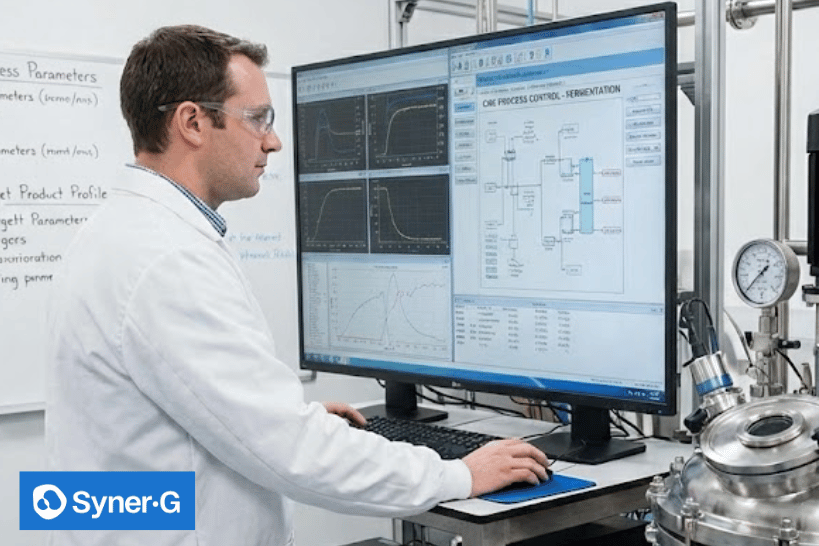
Process control plays a central role during process performance qualification (PPQ), a key part of process validation. During PPQ, a manufacturer must demonstrate that the process performs as intended and produces a product that meets quality standards. This requires close monitoring of all CPPs and review of product attributes.
Key activities during PPQ may include:
- Using small-scale or pilot lots to finalize process ranges
- Collecting data across multiple commercial-scale batches
- Comparing data to predefined acceptance criteria
- Assessing process reproducibility
After PPQ, continued process verification (CPV) begins. In this stage, the manufacturer evaluates whether the control strategy remains effective in the long term. Real-time data collection supports the detection of slow drifts or subtle changes that might not appear in individual batches.
CPV often includes:
- Batch trend analysis
- Annual product review
- Process capability indices (Cp/Cpk)
- Ongoing stability and CQA tracking
This continuous oversight ensures the process remains in control throughout commercial production.
Tools: From Statistical Process Control to PAT
Several tools support data collection and monitoring strategies in CMC process control. These tools help simplify analysis and increase visibility into complex processes.
Common tools and methodologies include:
- Statistical Process Control (SPC): Uses control charts and statistical analysis to detect variation and trends within a manufacturing process.
- Process Analytical Technology (PAT): Involves real-time sensors and analytical methods to monitor CPPs and CQAs during manufacturing.
- Design of Experiments (DoE): Helps determine which parameters have the most significant effect on product quality.
- Risk assessments (e.g., FMEA, Ishikawa diagrams): Support the prioritization of critical attributes and risks.
- Modeling and simulation: Offers predictive capabilities for scale-up and technology transfer.
These tools support a shift from reactive to proactive control models, where potential issues are addressed before they affect quality.
Process control systems can be categorized based on how they use feedback to manage variation.
| Type of Control | Description |
|---|---|
| Open-Loop Control | Executes actions based on predefined inputs. |
| Closed-Loop Control | Adjusts process parameters based on real-time feedback to maintain optimal conditions. |
Most modern manufacturing systems use closed-loop control, where real-time data is fed back to adjust process parameters continuously. Automated systems, often controlled through software integrations or Distributed Control Systems (DCS), improve reproducibility and reduce human error.
Common Challenges and Regulatory Considerations
Implementing process control strategies in CMC is not without challenges. Pharmaceutical manufacturers must address several technical and regulatory hurdles, including:
- Variability in raw materials, particularly in biological systems
- Difficulty scaling from development to full production
- Incomplete understanding of product-process relationships
- Limited historical data during early development
- Differing requirements and terminology among global regulators
Regulatory authorities require clear documentation of process control activities, especially in marketing applications and inspection readiness. Submissions must include:
- Justification for the selection of CPPs and CMAs
- Rationale for the control strategy and its relationship to CQAs
- Evidence of successful PPQ and long-term verification plans
Failing to demonstrate effective process control can delay approvals or trigger inspection findings.
Integrating Process Control into the Biopharmaceutical Lifecycle
Process control in CMC is essential to developing and manufacturing high-quality biologics and pharmaceuticals. It ensures the manufacturing process is consistent, reliable, and aligned with predefined quality standards. By identifying CPPs and CMAs, validating control strategies, and monitoring performance over time, companies can comply with regulatory requirements and maintain product integrity.
Rather than relying solely on end-product testing, process control builds quality into each step of production. Manufacturers that integrate strong process control frameworks can reduce risk, improve efficiency, and support successful regulatory submissions.
Frequently Asked Questions
How are CPPs determined?
CPPs are identified through a combination of process development studies, risk assessments, and statistical evaluations. Design of Experiments (DoE) can help determine which process parameters have a significant impact on product quality. Parameters that affect critical quality attributes and have narrow processing ranges are typically categorized as CPPs.
What is process control in pharmaceutical manufacturing?
Process control in pharmaceutical manufacturing refers to the methods and systems used to maintain process consistency and product quality. This includes monitoring equipment, adjusting parameters, and applying analytical tools to ensure each batch meets established specifications.
Why is process control important in PPQ?
During PPQ (Process Performance Qualification), process control proves that the manufacturing operation consistently produces acceptable product. Regulatory agencies require evidence that all CPPs are managed and that any variability is within a defined range. Without strong process control, the PPQ phase may fail, delaying product approval.
What tools are used in CMC process control?
Tools used in CMC process control include Statistical Process Control (SPC), Process Analytical Technology (PAT), Design of Experiments (DoE), and real-time monitoring through control systems. These tools help detect trends, manage risk, and ensure consistent process performance.
How does process control support regulatory submissions?
Process control supports regulatory submissions by providing documented proof of a stable, validated process. Submissions that include robust control strategies, lifecycle monitoring plans, and evidence of consistency across batches help regulators assess the safety and reliability of the product. A well-established process control plan can improve the likelihood of approval.